On this page
By See Komodo Dragons Editorial Desk
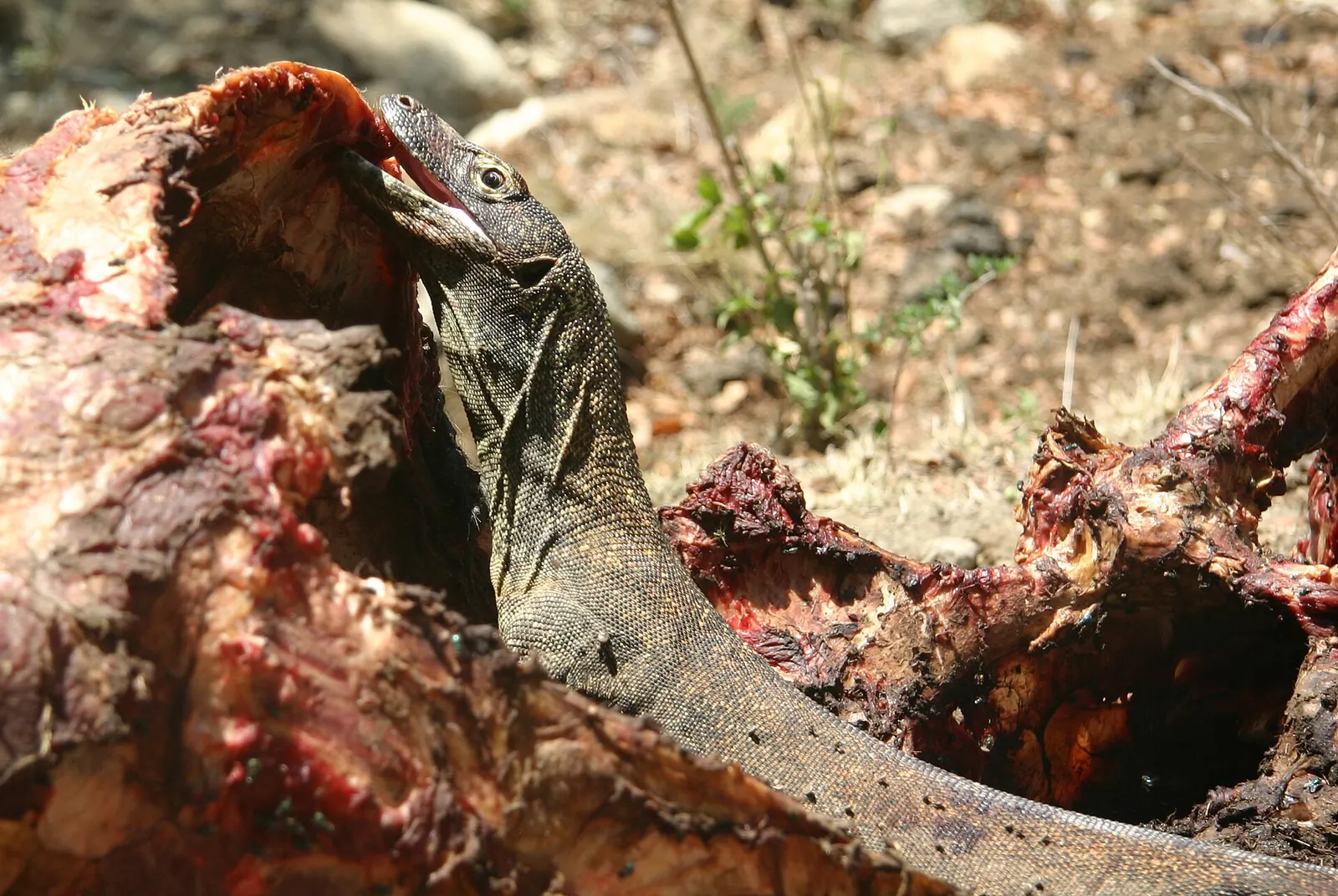
What do Komodo dragons eat? In the park, adults take wild pig, water buffalo, long-tailed macaque, Timor deer, Rinca rat and civet, according to the park authority, and they scavenge as well. Young dragons start on small lizards and insects. Visitors should not expect to watch a meal, and feeding wildlife is banned.
What do Komodo dragons eat as adults?
The park authority's fauna page gives the most useful local list, because it names animals that actually share these islands with the dragons.
| Prey named by the park authority | Why it matters to a visitor |
|---|---|
| Timor deer | So yes, dragons do eat deer. UNESCO counts this deer among the park's notable land species |
| Wild pig | Sits on the same list as the deer, and Wikivoyage also lists wild boar in the park |
| Water buffalo | Shows the size range of prey a large dragon takes on |
| Long-tailed macaque | The one primate on the list |
| Rinca rat | A rodent found only on Rinca, and hard to see |
| Civet | Also on Wikivoyage's list as palm civet; visitor sightings are not described |
The same page describes dragons as active by day, carnivorous, scavenging and occasionally cannibalistic. Scavenging matters because it widens the diet beyond what a dragon kills for itself: a carcass is food too. Occasional cannibalism is the authority's own description, and it comes with no rate attached. People do not appear on the prey list. Attacks on humans are a separate subject, covered on our page asking whether Komodo dragons are dangerous.
Portion size explains a good deal of the folklore. Smithsonian's National Zoo says an adult can eat up to 80 percent of its body weight in one meal, and adds that this may explain exaggerated weight claims. A dragon weighed after a large meal would give a misleading figure. Our page on how big Komodo dragons are deals with those size claims in detail.
Little gets left over. The zoo says dragons leave only about 12 percent of their prey, taking bones, hooves and hide along with the rest.
People also ask about birds, fish and snakes as prey, and whether food in a backpack draws a dragon. The park authority names six prey groups and says nothing on either point. Feeding and litter are banned under the park's visitor protocol. Komodo Resort, a dive operator, also advises not bringing food on trails, without citing a study. Neither the protocol nor the fauna page says whether food in a bag draws a dragon.
How do Komodo dragons hunt?
Mostly by waiting. Smithsonian's National Zoo says dragons wait along game trails and that most hunting attempts fail. Think of a heavy animal lying near a path that prey animals use, with a low success rate. The image of a dragon sprinting down prey over open country does not match this description, and a visitor could easily mistake the waiting for inactivity.
Smell plays a part in finding food that is already dead. Smithsonian's National Zoo says dragons can smell carrion up to 4 km away, which fits the scavenging the park authority describes. That distance applies to carrion and is not evidence about anything else a dragon might detect.
A dragon that appears to be doing nothing near a trail may therefore be working. That is one good reason to take your ranger's positioning seriously even when the animal looks asleep. The bite itself is a separate subject, and our page on the Komodo dragon bite covers venom and what became of the old bacteria story.
How does diet change with age?
The Komodo dragon diet changes sharply with age, and a hatchling and a large adult live almost as different animals. Sources line up well here, even though they emphasise different things.
| Life stage | Food and habit | Source |
|---|---|---|
| Young dragons | Small lizards and insects | Smithsonian's National Zoo |
| Up to about four years and 1.2 m | Live in trees | San Diego Zoo Wildlife Alliance |
| From about five years | Move on to larger prey | Smithsonian's National Zoo |
| Adults | Deer, pig, buffalo and other mammals, plus scavenging | Park authority |
The two zoo sources give slightly different ages for slightly different changes: one for leaving the trees, the other for shifting to bigger prey. We have kept them apart and have not merged them into one milestone. Their common message is that the first years are spent small and off the ground, and the switch to large mammals comes later.
When did goat feedings end, and what did they change?
Komodo dragon feeding was once part of the visit, with bait provided. The Komodo Guide site, a community guide, says rangers staged dragon feedings with tethered goats at Banunggulung until 1990. A 2018 study in Biodiversity and Conservation dates tourist-linked feeding to the 1980s and 1990s. The two dates do not quite match, so 1990 should be read as one account of the end point and not as a settled date.
The study shows why it mattered. It cites earlier work finding that this feeding led to six-fold density increases at feeding sites, a measure of how far a regular food source can change where animals gather. Neither source records who decided to stop or the official reason.
The rule today is clear. The park's visitor protocol bans feeding wildlife. That covers more than goats: a thrown snack counts too. Our summary of the Komodo National Park rules sets the ban among the other prohibitions, and the wider argument about visitors and dragon behaviour continues on the page asking whether tourism harms Komodo dragons.
Could you see a dragon feed?
You could, but do not plan on it. Feeding is banned, so a meal happens when a dragon finds or catches something, and that is unrelated to when your group walks by. Combine that with most hunts failing, and the chance of seeing a kill on one short guided walk looks small, although we know of no figure. Nobody should sell you a trip on the promise of a feeding, and nothing we write is a promise of one. If an offer suggests a staged feeding, ask how that squares with the protocol.
If you do come across an animal at a carcass, your ranger's instructions take priority over your camera. Our record of attacks includes a tourist bitten in 2017 while photographing feeding dragons.
What else do people ask about feeding?
Can I see Komodo dragons eating in the wild?
It can happen by chance, but no one can arrange it, because feeding wildlife is banned under the park's protocol and baited feedings ended decades ago. Treat any meal you witness as luck, and stay where your ranger puts you.
Can I watch a Komodo dragon hunt?
Unlikely. Smithsonian's National Zoo describes an animal that waits along game trails, and it says most attempts fail. A short guided walk overlaps with very little of that. No published figure tells you how often visitors see one.
What do Komodo dragons eat in Komodo National Park?
The park authority lists wild pig, water buffalo, long-tailed macaque, Timor deer, Rinca rat and civet. It also describes the species as a scavenger and as occasionally cannibalistic.
Are Komodo dragons cannibals?
Occasionally, according to the park authority. It gives no rate in that line.
Which sources support this page?
- Komodo National Park authority: fauna page
- UNESCO World Heritage Centre: Komodo National Park
- Wikivoyage: Komodo National Park
- Smithsonian's National Zoo: Komodo dragon
- San Diego Zoo Wildlife Alliance: Komodo dragon
- Komodo Guide: Loh Liang ranger station
- Biodiversity and Conservation: 2018 study (PDF copy)
- Komodo National Park: visitor protocol
- Komodo Resort: visiting Komodo with kids, 2026
How do I reach the desk?
Want to ask what a walk involves? Reach the desk on WhatsApp at +62 811-3823-875 or by emailing the desk. It cannot line up a feeding or any other sighting. An enquiry may become a paid booking, which is where our commercial interest lies, and a written offer is the only commitment.
Send the desk your dates and where you are coming from. The desk replies in writing.
Ask the desk on WhatsApp sales@komodoluxury.com