On this page
- When is Komodo dragon mating season?
- When do they nest and hatch?
- What happens to hatchlings?
- Why do incubation figures differ?
- What might a visitor notice?
- Does tourism disturb breeding?
- Can a female breed without a male?
- What do published accounts say about male combat?
- Should you plan a trip around breeding season?
- What else do readers ask about breeding?
- Which sources support this page?
- How do I reach the desk?
By See Komodo Dragons Editorial Desk
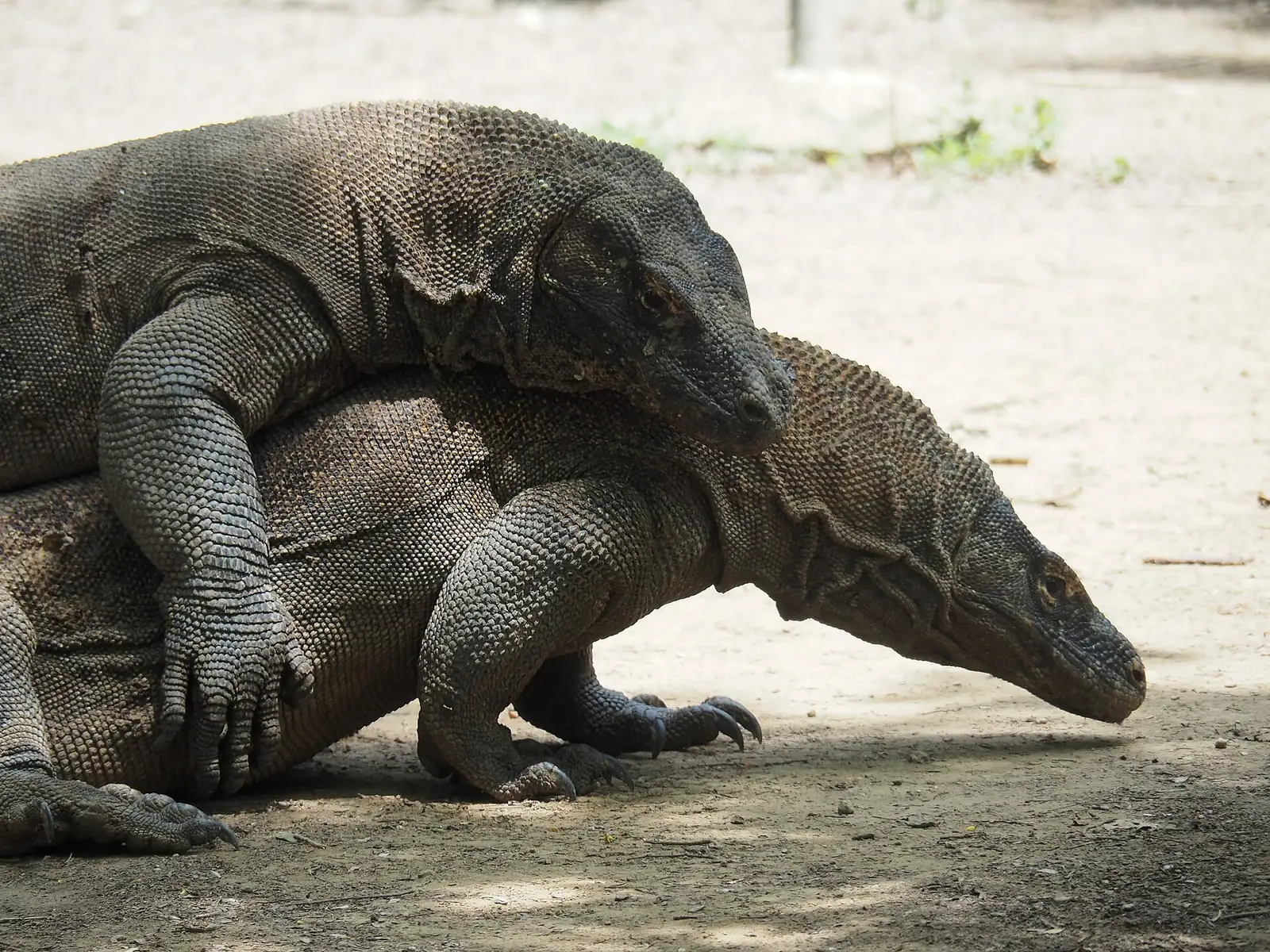
Komodo dragon mating season runs from May to August, according to Smithsonian's National Zoo and Wikipedia. San Diego Zoo Wildlife Alliance places nest digging in August and September, and Wikipedia has eggs laid in September and hatching in April. This calendar is general. It does not forecast what you will see on any walk.
When is Komodo dragon mating season?
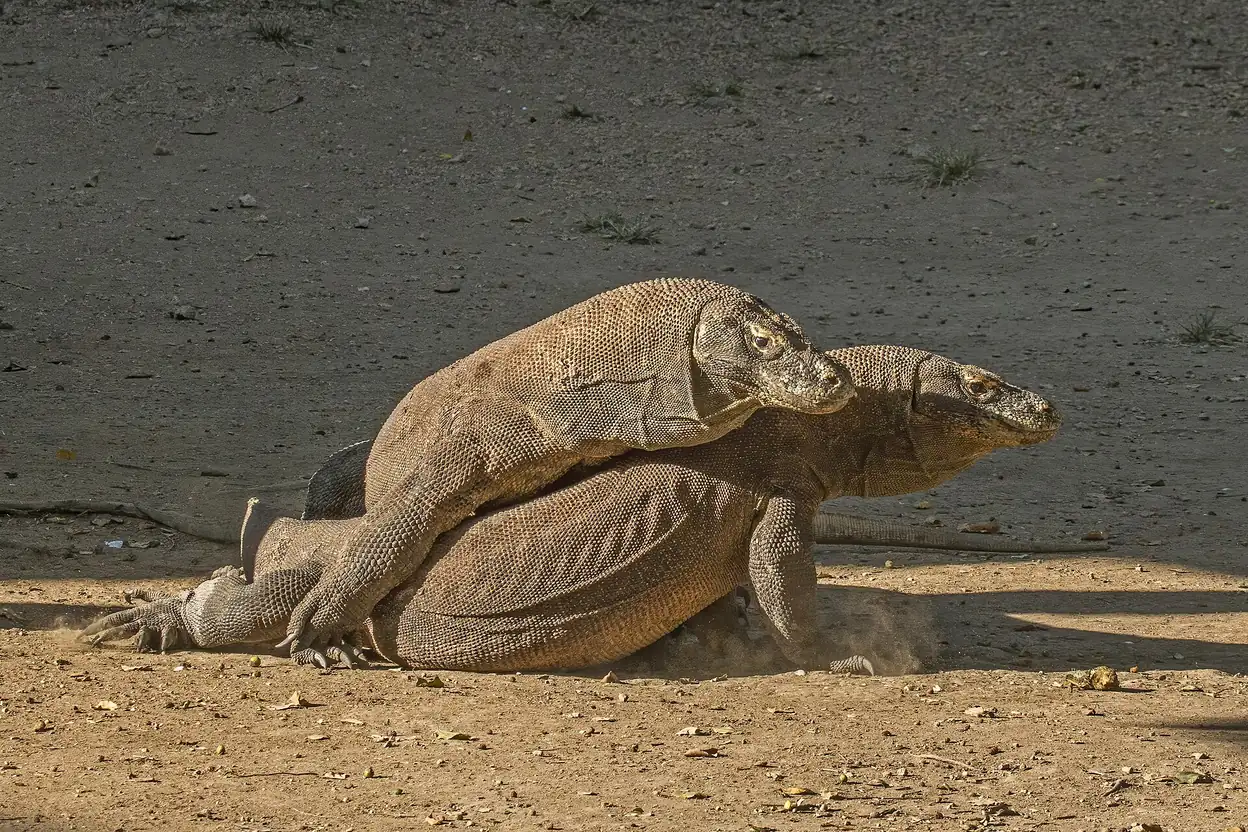
Both Smithsonian's National Zoo and Wikipedia put mating in the months from May to August. The calendar below follows the breeding year from there. Each row names one source, because they do not all agree on the later stages. Our season page combines them into one composite column and flags the incubation conflict.
| When | What happens | Source | What a visitor might notice |
|---|---|---|---|
| May to August | Mating | Smithsonian's National Zoo; Wikipedia | Males wrestling upright, using their tails for support |
| August and September | Females dig nests | San Diego Zoo Wildlife Alliance | No source describes this for visitors |
| September | Eggs laid | Wikipedia | Females guarding nests, looking thin |
| April | Eggs hatch | Wikipedia | Hatchlings are small and may be hard to spot |
| Up to about four years old | Young dragons live in trees | San Diego Zoo Wildlife Alliance | No source describes this for visitors |
Not every adult female takes part in a given year. San Diego Zoo Wildlife Alliance says females do not breed every year, so the calendar describes the species and tells you little about any one animal.
When do they nest and hatch?
Komodo dragons lay eggs. San Diego Zoo Wildlife Alliance describes three types of nest: hillside nests, ground nests, and mounds built by orange-footed scrubfowl, so a bird's mound can double as a dragon's nest.
The nest then ties the female down. The park authority says females guarding nests do not eat and often look thinner and smaller than males. If you see a lean dragon on a walk during these months, that may be the reason. Do not assume illness, and do not assume it is harmless either.
Month boundaries are soft. August counts as mating on the Smithsonian and Wikipedia calendars and as nest digging on San Diego's, so a single month can hold both stages. Growth after hatching, including what a five-year-old weighs, is on our page about how big Komodo dragons get. Responsible Travel, a tour seller, says up to 20 eggs are laid, without citing a study.
What happens to hatchlings?
They start small and eat small. Smithsonian's National Zoo says young dragons eat small lizards and insects and move to larger prey at about five years. Wikipedia notes proficient tree climbing when young, which fits San Diego's account of young dragons living in trees.
You may also read that adults eat their young. The park authority does describe dragons as occasionally cannibalistic, and it is tempting to connect that with life in the trees. That link is our question, since no source draws it.
Why do incubation figures differ?
Three sources give three answers, and the differences change the likely hatching month.
| Source | Incubation | If eggs are laid in mid-September |
|---|---|---|
| Park authority | 221 days | Hatching around late April |
| Wikipedia | Seven to eight months | Hatching around April to May |
| Smithsonian's National Zoo | About nine months | Hatching around June |
The last column is our arithmetic, starting from the September laying date in Wikipedia. The sources themselves do not explain the gap, and none of them says whether its figure comes from wild nests or captive animals. We would treat the park authority's 221 days as the figure closest to the place you will visit, since it comes from the park's own fauna page, but we cannot prove it is the most accurate. Any of these could be right for a given nest.
For a traveller, the disagreement has one useful consequence: do not fix a trip around a hatching date. The sources give no date for hatchlings emerging on a given island, or any odds of seeing them.
What might a visitor notice?
You may notice nothing at all. Breeding behaviour happens on the animals' schedule. The sources describe three things worth knowing.
- Male combat. Smithsonian's National Zoo says dominant males wrestle upright, using their tails for support. This is the image many people have in mind. If you do see it, stay where your ranger puts you.
- Thin females. These are the easiest sign to misread. A nest-guarding female may look small beside a male without being a young animal.
- Young dragons overhead. San Diego Zoo Wildlife Alliance says the young stay in trees until they are about four and 1.2 m long. Smithsonian's National Zoo says hatchlings average 40 cm and weigh under 100 g, so a baby Komodo dragon is a small animal, and no source describes visitors seeing one.
Stay on the route and ask the ranger about any nest area. Our page on the best time to see Komodo dragons weighs these months against weather and the quota.
Does tourism disturb breeding?
The concern reached government level. In 2019, the BBC reported, a proposed closure was defended as a way to keep tourism out of dragon mating and hatching. National Geographic's account has visitors handing out food and disturbing mating as the trigger for that temporary closure of Komodo Island being considered.
Those are stated reasons and press descriptions. They do not amount to a measured effect on breeding success. Our page asking does tourism harm Komodo dragons goes through the wider evidence. On a walk, the protocol bans feeding wildlife and trekking off set routes, and the ranger's instruction decides the rest.
Can a female breed without a male?
You may read that female Komodo dragons can produce young without a male, a process called parthenogenesis. National Geographic describes it in general terms. The park authority's fauna page says past studies did not find it in wild individuals. Those two statements answer different questions: what the species is described as able to do, and what studies have recorded in the wild. Nothing here ties it to anything a visitor could observe on a walk.
What do published accounts say about male combat?
Rob Pilley, a herpetologist and filmmaker, told National Geographic that while filming in early August 2018, at the height of breeding, other males came out of the bushes behind his crew and rangers told them to get up. A Forbes contributor puts mating mainly in June and July, narrower than the May to August given above, and says duelling males are best avoided by tourists. These are individual accounts and not measured risk. On a visitor walk, where to stand during a fight is the ranger's decision.
Should you plan a trip around breeding season?
We would not. The mating months give you a chance of seeing behaviour that may not occur within sight of your route on your morning. A female may not be breeding that year. Hatchlings are small and take to the trees. If mating behaviour is your main reason for travelling, be honest with yourself about the odds, and treat anything you do see as a bonus.
Photographers hoping for male combat face the same uncertainty. Our page on photographing Komodo dragons covers the rules that apply.
What else do readers ask about breeding?
When is Komodo dragon nesting season?
Nest digging falls in August and September on San Diego Zoo Wildlife Alliance's account, with eggs laid in September on Wikipedia's. A female then guards the nest, and the park authority says she does not eat during this time.
When do Komodo dragon eggs hatch?
Wikipedia says April, after seven to eight months. The park authority gives an incubation of 221 days, and Smithsonian's National Zoo says about nine months.
Can visitors see Komodo dragon hatchlings?
No source describes visitors seeing hatchlings. Hatchlings average 40 cm, according to Smithsonian's National Zoo, and young dragons take to the trees. No one can promise one.
Can I see baby Komodo dragons in the wild?
No source describes visitors seeing one, and nobody can arrange it. San Diego Zoo Wildlife Alliance says the young stay in trees until about four years old.
Which sources support this page?
- Smithsonian's National Zoo: Komodo dragon
- Wikipedia: Komodo dragon
- San Diego Zoo Wildlife Alliance: Komodo dragon
- Komodo National Park authority: fauna page
- Responsible Travel: Komodo dragon tours
- BBC: Komodo Island closure plan, 2019
- National Geographic: Komodo dragon
- National Geographic: where Komodo dragons really live, 2020
- Forbes contributor: how and where to see Komodo dragons, 2024
How do I reach the desk?
Since requests to the desk can end in a paid booking, read us as having a commercial interest. Have a date range in mind and want to know what else is going on in the park then? The desk can talk it through, without any promise about what the animals will do. Reach it on WhatsApp at +62 811-3823-875, or email the desk.
Send the desk your dates and where you are coming from. The desk replies in writing.
Ask the desk on WhatsApp sales@komodoluxury.com